
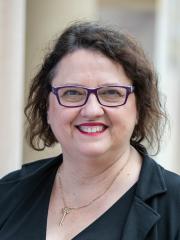
Dr Lorelle Holland is a proud Mandandanji woman who grew up on Turrbal Country with her four sisters and parents. She is a dedicated and passionate Registered Nurse with four decades of experience across clinical, management, education, and research roles in the health care sector. A highlight of her nursing career was working as a Remote Area Nurse in the Northern Territory, providing care alongside Aboriginal communities.
Lorelle currently holds the position of Research Fellow in Indigenous Health at the Poche Centre for Indigenous Health and the ARC Centre of Excellence for Indigenous Futures, and is an Affiliate at the School of Nursing, Midwifery and Social Work at The University of Queensland. She hopes to inspire the next generation of health equity researchers to enable thriving Indigenous futures.
A proud UQ alumna, Lorelle graduated with a Master of Public Health (Indigenous Health) in July 2020 and received the Postgraduate Coursework Academic Excellence Award, presented by Professor Bronwyn Fredericks (Pro-Vice-Chancellor, Indigenous Engagement) and Professor Tracey Bunda (Academic Director, Aboriginal and Torres Strait Islander Studies Unit).
Lorelle recently completed her Doctor of Philosophy at The University of Queensland. Her thesis, The Co-design of Transformative Healing and Adungadoo Pathways: Preventing the Criminalisation of Aboriginal and Torres Strait Islander Children with Complex Support Needs, promotes holistic community development across the life course to achieve Indigenous-led justice reinvestment. Guided by transformative epistemologies and decolonising methodologies, her research centres the voices of Aboriginal and Torres Strait Islander children and communities in designing culturally responsive, holistic assessment and diversionary pathways that uphold Indigenous sovereignty and self-determination.
Lorelle’s standpoint as an Aboriginal woman, combined with her extensive nursing experience and public health education, offers a broad and nuanced perspective on the complex interplay between environment, health systems, interdisciplinary collaboration, and the social determinants of health. She advocates for the decolonisation of health and justice interventions, grounded in the United Nations Declaration on the Rights of Indigenous Peoples (UNDRIP), which affirms the rights of Indigenous peoples to lead transformative change through their own knowledges, strengths, and sovereignty.